Hook-and-loop fastens across a mating contact zone and can be positioned without fixed buckle-hole steps. A traditional buckle places a pin through one of several holes and routes the loose tail through a keeper. Pin-and-tuck also uses fixed holes, but the free end tucks underneath the band. None of these closure labels, by itself, proves better comfort, security, durability, or workout performance.
Hook-and-loop vs buckle vs pin-and-tuck at a glance
| Closure | How it fastens | Adjustment pattern | Loose-tail position |
|---|---|---|---|
| Hook-and-loop | Two mating contact surfaces overlap | Positioned within the usable contact zone | Folds back across the band |
| Traditional buckle | A pin passes through a selected hole | Fixed hole positions | Routes through a keeper |
| Pin-and-tuck | A metal pin passes through a selected hole | Fixed hole positions | Tucks underneath the band |
This is a mechanical comparison, not a performance ranking. The closure name does not establish how a particular band will feel on your wrist, how long it will last, or how it will behave in a specific workout.
See the three closure layouts on real BlackPro products
These are current BlackPro Amazon product images, processed only so the catalog-white image background matches the site’s #e9e7df product canvas. The products themselves were not regenerated.
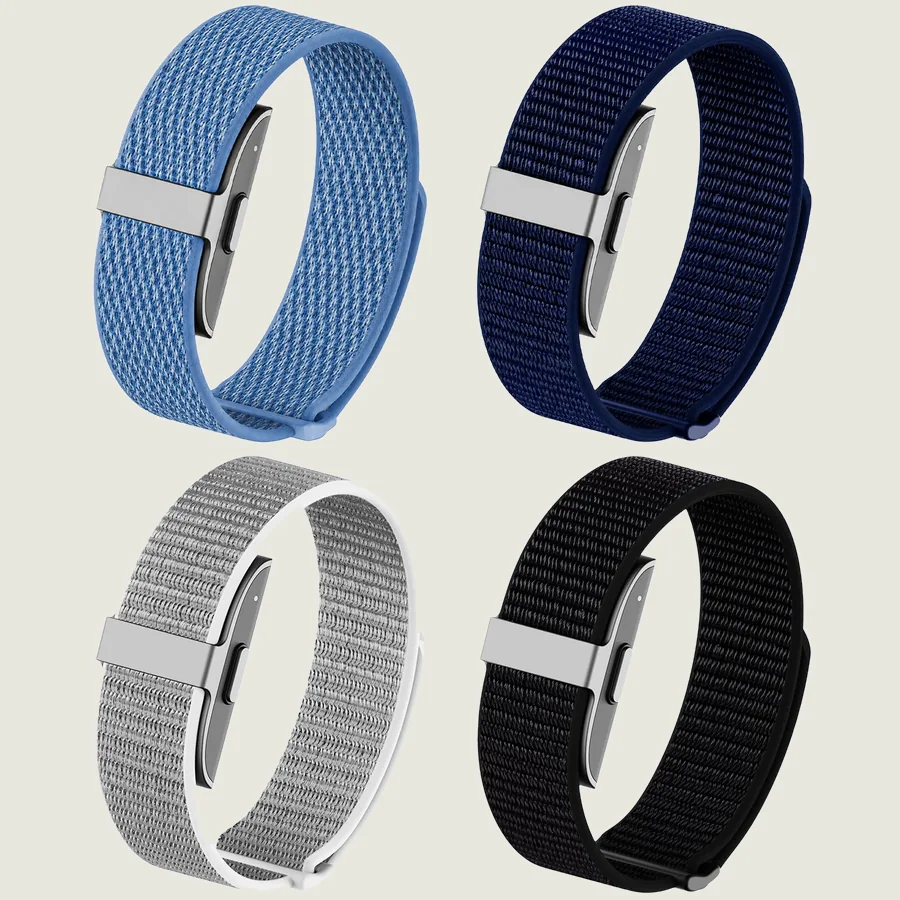
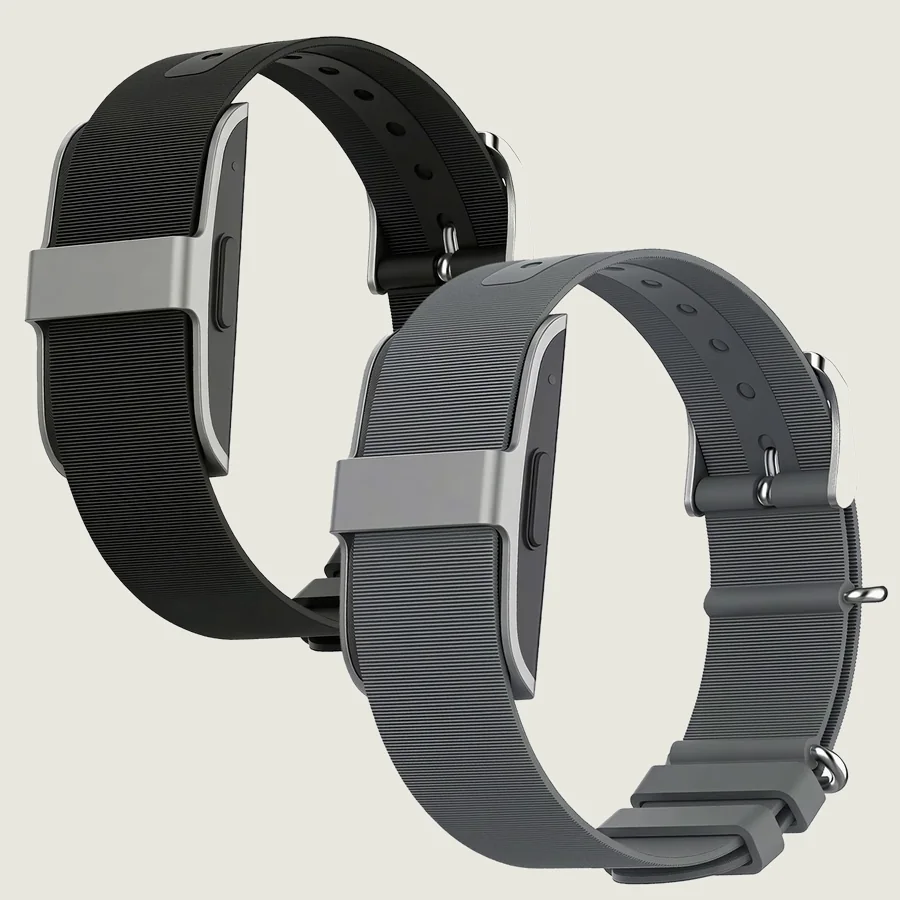
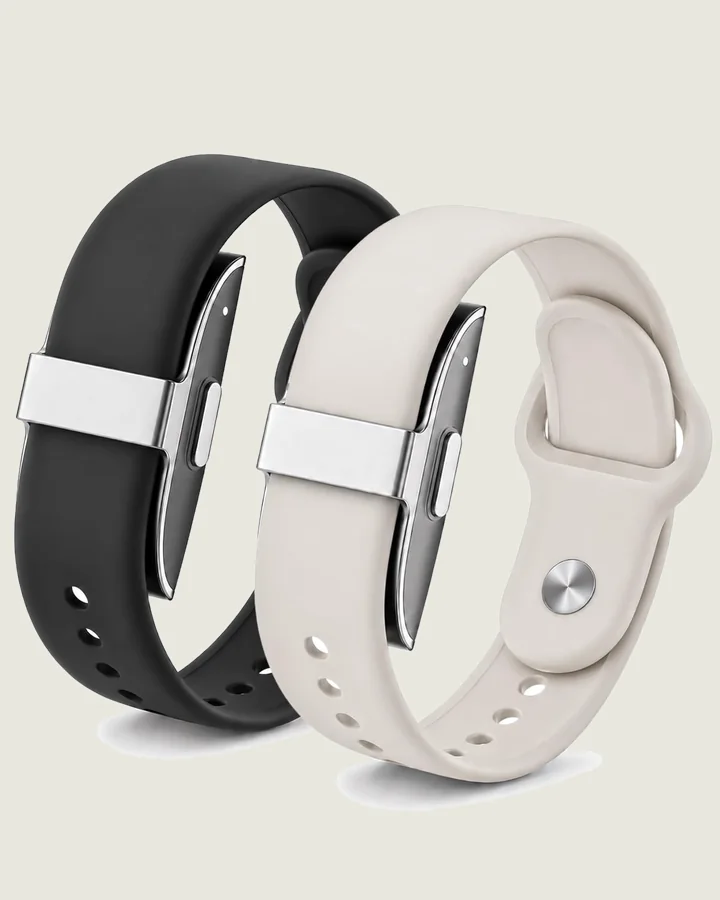
Hook-and-loop
Hook-and-loop designs fasten when the mating surfaces overlap. The wearing position can be set within the usable contact zone instead of being limited to a row of buckle holes. Apple and Garmin use the same broad closure term in their own band documentation; those first-party pages establish the mechanism’s terminology, not a performance claim for BlackPro products.
Buckle
A traditional buckle uses one of several fixed holes and a keeper for the free end. BlackPro’s current Hume example is described across its Amazon page as a T-buckle, while the title also uses “clasp buckle closure.” This guide keeps both listing terms visible rather than silently choosing one.
Pin-and-tuck
A pin-and-tuck band also fastens at fixed holes. Its distinguishing layout is tail management: the free end is tucked underneath the band instead of passing through an external keeper. Apple uses “pin-and-tuck” for its own Sport Band; the current BlackPro listings use the term for the Hume silicone sport duo and two Fitbit Air silicone options.
Adjustment pattern and tail management are separate questions
First ask whether you prefer adjustment within a contact zone or at fixed holes. Then ask where you want the free end to sit: folded back across the band, routed through a keeper, or tucked underneath. Those two questions describe the visible mechanics more accurately than asking which closure is “best.”
Hole spacing, hook-and-loop contact length, band thickness, total length, and the connector shape are product-specific. A closure category cannot substitute for the published wrist range or exact tracker compatibility.
Current BlackPro closure examples
For Hume Band 1.0
- Breathable Nylon Loop 2-Pack: woven nylon with hook-and-loop adjustment. The pack count is consistent, but Amazon currently shows two conflicting wrist ranges.
- Nylon Sport Loop Set: a multi-color woven nylon hook-and-loop option. Amazon currently contains conflicting pack-count and wrist-range text, so this site does not publish either as settled.
- Classic Silicone Buckle Band 2-Pack: silicone with a T-buckle, described in the Amazon title as a clasp-buckle closure; current listed fit is 6.4–8.8 inches.
- Silicone Sport Duo: two silicone bands with metal-pin, pin-and-tuck closures; current listed fit is 6.50–8.86 inches.
For Google Fitbit Air
- Nylon Performance Loops: a three-band woven nylon set with hook-and-loop adjustment; current listed fit is 5.1–8.3 inches.
- Silicone Active Band 2-Pack and the Everyday Active Band: silicone pin-and-tuck options with metal pins; both currently list a 6.3–7.9-inch fit.
Amazon pages can contain text from multiple content blocks. When those blocks conflict, BlackPro shows a verification note instead of selecting the more convenient number. Price, stock, selected variation, shipping, and returns must also be checked on Amazon.
A closure is not a material
“Hook-and-loop,” “buckle,” and “pin-and-tuck” describe how a band fastens. “Woven nylon,” “silicone,” and “FKM fluororubber” describe the band material. Keep the decisions separate: two bands can share a closure but use different materials, or share a material but use different closures.
For example, BlackPro’s current Hume catalog includes silicone with T-clasp, T-buckle, and pin-and-tuck labels. Read the nylon vs silicone vs FKM guide for a material comparison, then return to the closure and product-specific fit.
Pre-order closure checklist
- Confirm the exact tracker: Hume Band 1.0 or Google Fitbit Air.
- Choose between contact-zone adjustment and fixed hole positions.
- Check whether the loose tail folds back, uses a keeper, or tucks underneath.
- Compare your wrist measurement with the exact selected variation.
- Confirm material, pack count, and color separately from closure type.
- Recheck any visible listing-conflict note immediately before checkout.
Where BlackPro T-clasp bands fit in this comparison
BlackPro also currently lists silicone and FKM Hume Band 1.0 products with a T-clasp. That is a separate catalog label from the T-buckle and pin-and-tuck examples above, so it should not be folded into either category without product-specific evidence.
Sources and product references
Device specifications and retail details can change. The linked first-party pages and current BlackPro Amazon listings remain the source of truth.
- Apple — Sport Loop with hook-and-loop fastener ↗
- Garmin — attaching a hook-and-loop band ↗
- Apple — Sport Band with pin-and-tuck closure ↗
- Google Store — Fitbit Charge sport band buckle terminology ↗
- BlackPro Hume nylon loop 2-pack — Amazon ↗
- BlackPro Hume nylon sport loop set — Amazon ↗
- BlackPro Hume silicone T-buckle 2-pack — Amazon ↗
- BlackPro Hume silicone pin-and-tuck 2-pack — Amazon ↗
- BlackPro Fitbit Air nylon hook-and-loop 3-pack — Amazon ↗
- BlackPro Fitbit Air silicone pin-and-tuck 2-pack — Amazon ↗
- BlackPro Fitbit Air everyday pin-and-tuck band — Amazon ↗